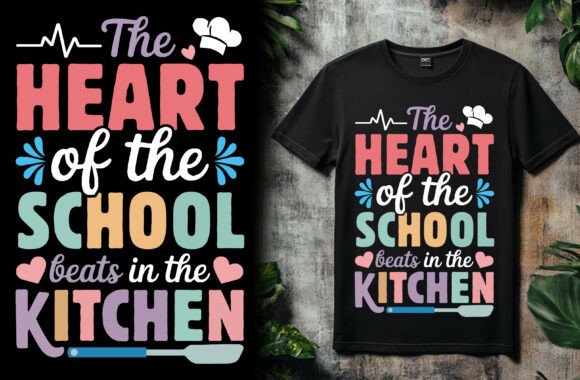
The Heart of the School Beats in the Kit
A Warm, Nostalgic Pulse—Not Just Another School Motif
First glance at The Heart of the School Beats in the Kit lands softly—not with bold graphics or sharp edges, but with a gentle, centered heart cradling kitchen-themed elements: a whisk, an oven mitt, maybe a subtle spoon or rolling pin. It’s warm. It’s human. It doesn’t shout “school spirit” like a pep rally; it whispers “this is where care happens.” As someone who’s stitched hundreds of custom pieces for teachers, PTA groups, and boutique kitchen shops, I immediately pictured this on a heavyweight cotton apron—stitched in soft red and cream thread, slightly off-center above the pocket. That’s where it breathes.
Where This Design Finds Its True Rhythm
The Heart of the School Beats in the Kit thrives in handmade product contexts where story matters more than scale. Think embroidered tote bags for school bake sales, cozy sweatshirt embroidery for cafeteria staff gifts, or pillow covers for teacher lounge decor. It works beautifully as a machine embroidery design on stable fabrics—medium-weight twill for aprons, fleece-backed cotton for baby onesies (yes, even baby embroidery), or terry cloth for kitchen towels. The layout is balanced but not rigid: the heart anchors the composition, while supporting icons have breathing room—no overcrowding, no frantic fill stitch density that risks puckering.
I recently tested a near-identical concept on a 100% cotton tea towel—light stabilizer, 40-weight polyester thread, medium-speed stitching—and the result felt intentional, not automated. Customers noticed it. One buyer wrote, “It made my gift feel personal, not printed.” That’s the quiet power of The Heart of the School Beats in the Kit: it reads as crafted, not copied.
Real Limits You’ll Feel—Not Just Read in the Specs
This isn’t a one-size-fits-all embroidery file. On curved surfaces like caps or structured hats, the heart’s rounded shape holds up better than angular lettering—but only if you use a smaller-scale version. Don’t force the full-size design into a 3” hoop without checking how the inner details (like tiny whisk tines or mitt stitching lines) translate. On stretchy fabric—say, a lightweight jersey t-shirt—the satin stitch outlines may ripple unless you pair it with cutaway stabilizer and reduce tension slightly. And on dark fabric? Test thread colors first. A light beige fill stitch can disappear against navy fleece unless contrast is built in at the digitizing stage—which, based on the description, isn’t specified here. Proceed with mockups.
Also: avoid dense decorative accents *inside* the heart unless your machine handles fine detail reliably. If the file includes tight running stitch flourishes or layered applique design elements, verify they’re optimized for home embroidery machines—not just commercial setups. Not all Graphics files are created equal for small-shop production.
What It Adds to Your Finished Product—Beyond the Stitch
When used thoughtfully, The Heart of the School Beats in the Kit lifts perceived value. It signals care—not just “I bought a shirt,” but “I chose something that honors where learning and nourishment meet.” That resonance builds customer trust, especially for Etsy sellers and small shop owners curating meaningful T-Shirt Designs. Teachers buy these as holiday embroidery gifts. Cafeteria teams order them for staff appreciation. Parents commission them as personalized gifts for their child’s favorite lunch lady. It’s branding with heartbeat—not logo, not slogan, but shared feeling.
Visually, it avoids cliché. No clipart apples, no cartoonish chalkboards. That makes it easier to maintain brand consistency across products—a matching set of embroidered pillow cover + tea towel + tote bag feels cohesive, not repetitive. And because it leans into warmth over whimsy, it photographs well in printable mockups, helping digital embroidery file sellers stand out in crowded marketplaces.
Practical Designer Notes Before You Stitch
- Always test on scrap fabric matching your final product’s weight and stretch—even if it’s just a corner swatch.
- Check thread color contrast on both light and dark fabric backgrounds before committing to a full run.
- Review stitch density in the heart’s center and around icon outlines—high density on thin fabric = stiffness and potential fraying after washing.
- Confirm hoop size compatibility. If your machine maxes out at 4x4”, does the file offer a scaled-down version—or will you need to resize carefully?
- Inspect small details at actual stitch size: are whisk lines distinct? Does the oven mitt’s cuff read clearly at 2.5” wide?
- Try a black-and-white mockup—it reveals clarity issues no color preview catches.
- Use appropriate stabilizer: tear-away for stable cottons, cutaway for knits or frequent-wash items like baby embroidery or kitchen towels.
- Verify licensing before selling finished products or bundling the embroidery file as part of a craft business kit—especially for commercial embroidery or digital product previews.
Final Thought: It’s Not About the Kit—It’s About the Keepers
The Heart of the School Beats in the Kit won’t dominate a tradeshow booth or trend on TikTok. But it will live quietly in a teacher’s drawer, on a parent’s coffee mug, stitched onto the sleeve of a volunteer’s apron. It’s a design that earns its place—not by shouting, but by staying. For embroidery designers, Etsy sellers, and creative entrepreneurs building real relationships through handmade product, that kind of quiet resonance is worth more than flash. Just make sure your execution matches its intention: steady, sincere, and stitched with care.